Publish and manage needs
A good task is specific enough that a supporter can act without guessing. It describes one needed good or activity, with realistic demand, place, and timing.
Create a task
Open Manage → Tasks → Add task. Search the catalogue for the needed item or activity, then complete its row.
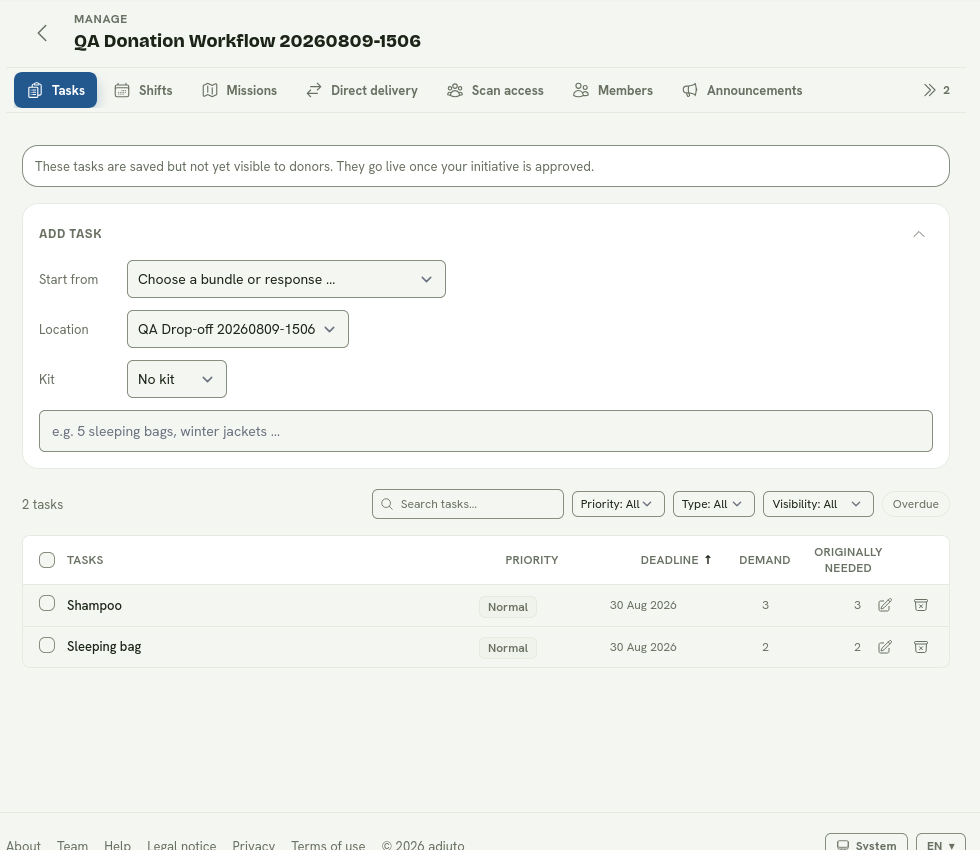
Task creation and the existing list share one workspace, so coordinators retain context while publishing a need.
Depending on the task, set:
- Demand and unit: how much is genuinely needed now;
- Location: required for goods, optional only when the task supports remote help;
- Priority: normal, important, or urgent;
- Deadline: when the need closes;
- Recurrence: daily, weekly, or monthly replenishment for ongoing demand;
- Visibility: public, members only, or inactive;
- Note: condition, compatibility, access, or other information supporters need;
- Shifts: specific start, end, and capacity for scheduled work.
Some catalogue items require attributes such as condition, size, operating system, connector, or compatibility. Complete them carefully; they prevent unusable donations.
Set realistic demand
Demand should reflect what the initiative can use and receive within the task period. A huge number discourages supporters and hides progress; an understated number fills too quickly. For ongoing use, prefer realistic recurring demand over one permanently large total.
When a mission is committed, its amount is reserved from open demand. Cancellation or expiry makes the amount available again; a confirmed handover records it as delivered.
Create a kit
A kit groups goods that must be donated together, such as one hygiene set containing fixed quantities of several products. Name the kit, set how many complete kits are needed, and specify the amount of each component per kit.
Supporters choose complete kits. Once a kit component has been part of a committed mission, changing the composition is restricted; maintain shared priority, deadline, recurrence, and location at kit level.
Members-only needs
Choose members-only visibility for internal needs that active initiative members may fulfil. These tasks do not appear in public search and cannot be opened by non-members.
Manage existing tasks
The Tasks tab supports search and bulk changes to priority, deadline, demand, status, and archiving. You can also open one task for more detail.
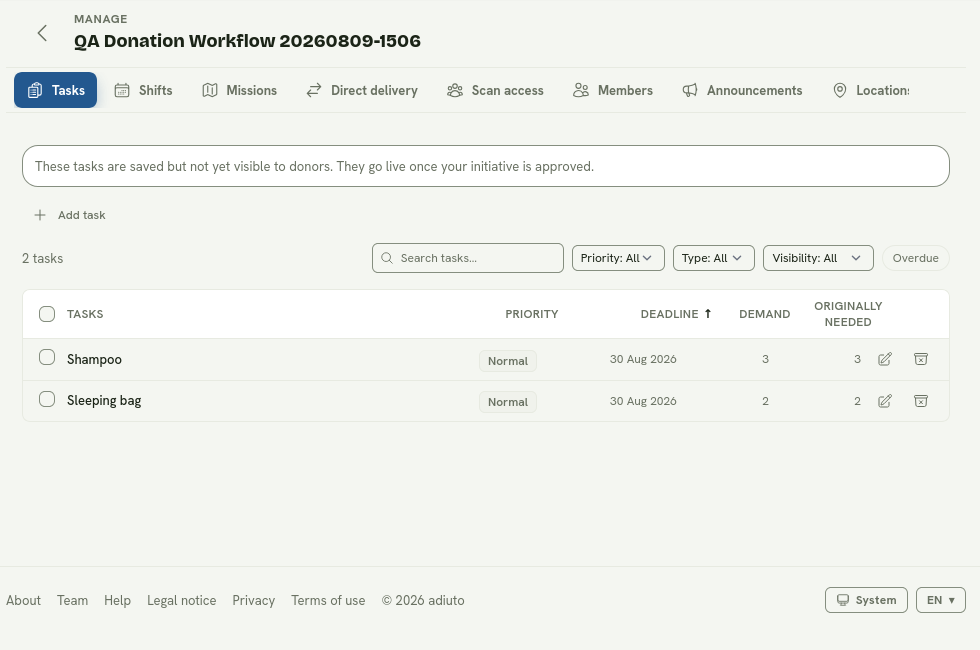
Filters and row actions keep routine maintenance in one compact overview.
- Inactive keeps a task out of public use until reactivated.
- Fulfilled means its open demand reached zero.
- Closed means its deadline passed.
- Archived retires it from normal use.
Do not archive a task merely because today’s quantity was met if the need should recur. Configure recurrence or restore the demand instead.
Export tasks as CSV or JSON
Initiative coordinators and administrators can download the task list from Manage → Tasks. Once the initiative has tasks, the buttons above the list offer two formats:
- Export CSV: a spreadsheet file for Excel or LibreOffice. Dates and times use your display time zone, and the column separator follows your interface language.
- Export JSON: structured data for scripts and other programs, with timestamps in UTC.
Both formats include every non-archived task in the initiative, including inactive tasks and tasks with no remaining open demand. The search, filters, selected rows, and current table page do not limit the export.
The file includes task names, quantities, priorities, deadlines, locations, notes, and links to the tasks. Shift tasks include upcoming occurrences through the task deadline, including fully booked shifts. Individual bookings and volunteer names are not included.